
 Repair Tools
 Glass Refurbishment
 Chips & Components
 Accessories
 Apple
Apple
 Mac
Mac
 Samsung
 Brands
 REPART
 Other Parts
No relevant results
Do Third Party High-Capacity iPhone Batteries Actually Last Longer?
Sep 08, 2026
747
0
If your iPhone battery no longer makes it through the day, replacing it is usually an easy decision. The harder part is choosing what to replace it with.
Alongside the standard-capacity OEM batteries, repair shops now offer high-capacity options that promise more usable time between charges. Some give a modest increase, while others are capacity much higher than the battery originally fitted to the phone.
At first glance, that sounds simple. In practice, capacity matters alongside cell quality, battery management, temperature control, charge reporting, and long-term stability. Let’s use the REPART iPhone 13 battery as an example, then look at why the capacity increase changes from one iPhone model to another.
What Does "High-Capacity" Really Mean?
The standard iPhone 13 battery is capacity at about 3,227mAh and 12.41Wh. The REPART iPhone 13 high-capacity battery is capacity at 3,450mAh, 3.84V, and 13.25Wh, with a 4.47V charge-limit voltage. That works out to roughly 7% more rated capacity.
Seven percent may not sound dramatic, but for someone who regularly finishes the day with little charge left, even a modest increase can be useful. The important point is that 7% is not a rule for every model.
For example, the iPhone 16 Pro has a standard-capacity figure of 3,582mAh, while a REPART high-capacity option is rated at 3,800mAh. That is an increase of about 6%. The iPhone 16 Pro Max shows a bigger spread. A standard-capacity battery is around 4,685mAh. REPART offers a 5,050mAh TI version and a 5,297mAh Select version, roughly 8% and 13% higher respectively.
Across the wider Select range, REPART lists some batteries with capacity increases of up to 39% compared with standard OEM-spec replacements. So when you see "high-capacity," don't assume a fixed percentage. Check the actual mAh figure for the model you're repairing.
Does More mAh Mean More Runtime?
Usually, the more genuine capacity gives the phone more energy to work with. But a 10% increase in mAh does not guarantee exactly 10% more screen time.
How long an iPhone lasts depends heavily on how it's used.
Watching video at moderate brightness is very different from recording 4K video, gaming, using GPS, or dealing with a poor cellular signal. Screen brightness, background apps, 5G, temperature, and processor load all change power use. That's why it's better to talk about rated capacity rather than promising a fixed number of extra hours.
A 3,450mAh iPhone 13 battery has more rated capacity than a 3,227mAh battery. Assuming both batteries are working properly, that gives the phone a larger energy reserve. The exact difference you notice from day to day will depend on how you use it. The standard iPhone 13 capacity of 3,227mAh and 12.41Wh is also documented by iFixit.
The Battery Chip Matters Too
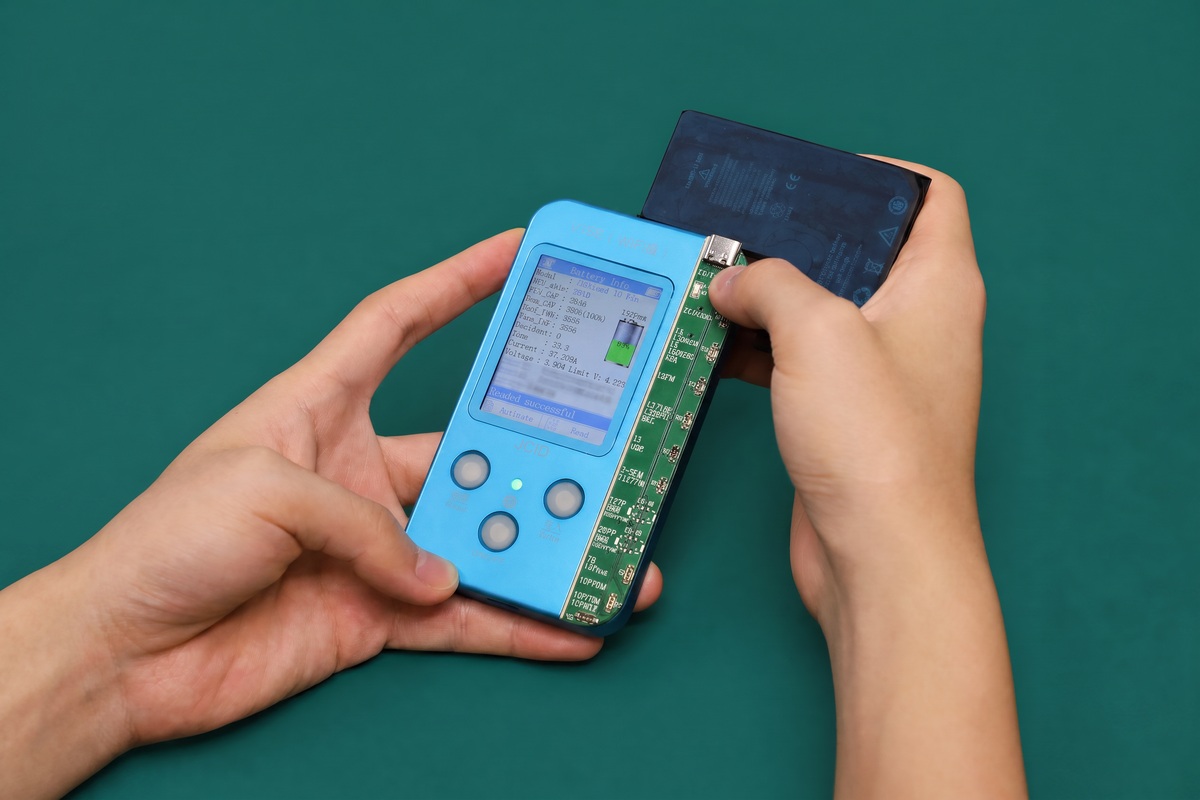
Capacity gets most of the attention because it's easy to compare. The electronics attached to the cell are less visible, but they have an important job. The REPART iPhone 13 battery uses a TI chip solution with Impedance Track technology. REPART rates the system for 1% state-of-charge precision.
In plain language, the battery-management system is trying to answer one question accurately: how much usable charge is actually left? It's harder than it sounds.
Battery voltage changes with temperature, load, age, and state of charge. Poor fuel gauge can lead to the familiar "ghost percentage" problem, where a phone appears to have plenty of battery left and then drops quickly or shuts down sooner than expected.
TI's Impedance Track approach is designed to estimate remaining capacity using factors such as battery impedance, temperature, discharge behavior, and age.
It doesn't create extra capacity. It helps us track the capacity that's already there more accurately.
What Does Less Than 10µA Standby Consumption Mean?
REPART also specifies less than 10µA static consumption for the battery management board. This does not mean the whole iPhone uses less than 10µA overnight. The phone is still powered by wireless connections, background services, notifications, memory, and other hardware.
The figure refers only to battery-management electronics. Keeping that draw low reduces the energy the battery board uses while the phone is idle. It's a small part of overall battery life, but it shows that efficiency is being considered beyond simply increasing cell capacity.
Temperature Control Still Matters
Lithium-ion batteries don't like extreme heat or cold. Temperature affects charging, available power, and long-term battery health. The REPART iPhone 13 battery includes integrated IC thermal monitoring for real-time temperature control, including low-temperature charging conditions.
That matters because added capacity should not come at the expense of basic protection. A good high-capacity battery needs to balance energy density with stable charging and discharge behavior. A bigger mAh number isn't automatically better if the battery management system or cell quality is poor.
Does a High-Capacity Battery Wear Out Faster?
Not necessarily.
Battery aging is affected by heat, charge cycles, charging conditions, storage, cell chemistry, and manufacturing quality. Two batteries with the same capacity can age very differently. REPART describes its iPhone 13 battery as using a Pure Cobalt cell, intended to provide stable chemistry and slow capacity degradation.
That's useful to know, but specific lifespan promises still need long-term test data. For repair shops, the practical question isn't just how many mAh are printed on the label. It's whether the battery combines useful capacity with dependable fuel gauging, temperature monitoring, low board consumption, and consistent cell quality.
So, Is a High-Capacity iPhone Battery Worth It?
If the phone already needs battery replacement, a high-capacity option can be a sensible upgrade. For the iPhone 13, the jump from 3,227mAh to 3,450mAh is about 7%. On other models, the increase may be smaller or considerably larger.
The iPhone 16 Pro Max, for example, can move from around 4,685mAh to 5,050mAh or 5,297mAh depending on the REPART battery series. For a light user, the difference may be modest. For someone spending the day on calls, navigation, video, social apps, or mobile work, extra stored energy can be useful.
The same applies to repair shops.
A standard-capacity battery remains the straightforward replacement, while a high-capacity version gives customers an upgrade option when longer runtime matters to them.
It also gives technicians a clearer way to offer different levels of replacement instead of treating every battery as essentially the same product.
Don't Choose a Battery by Capacity Alone
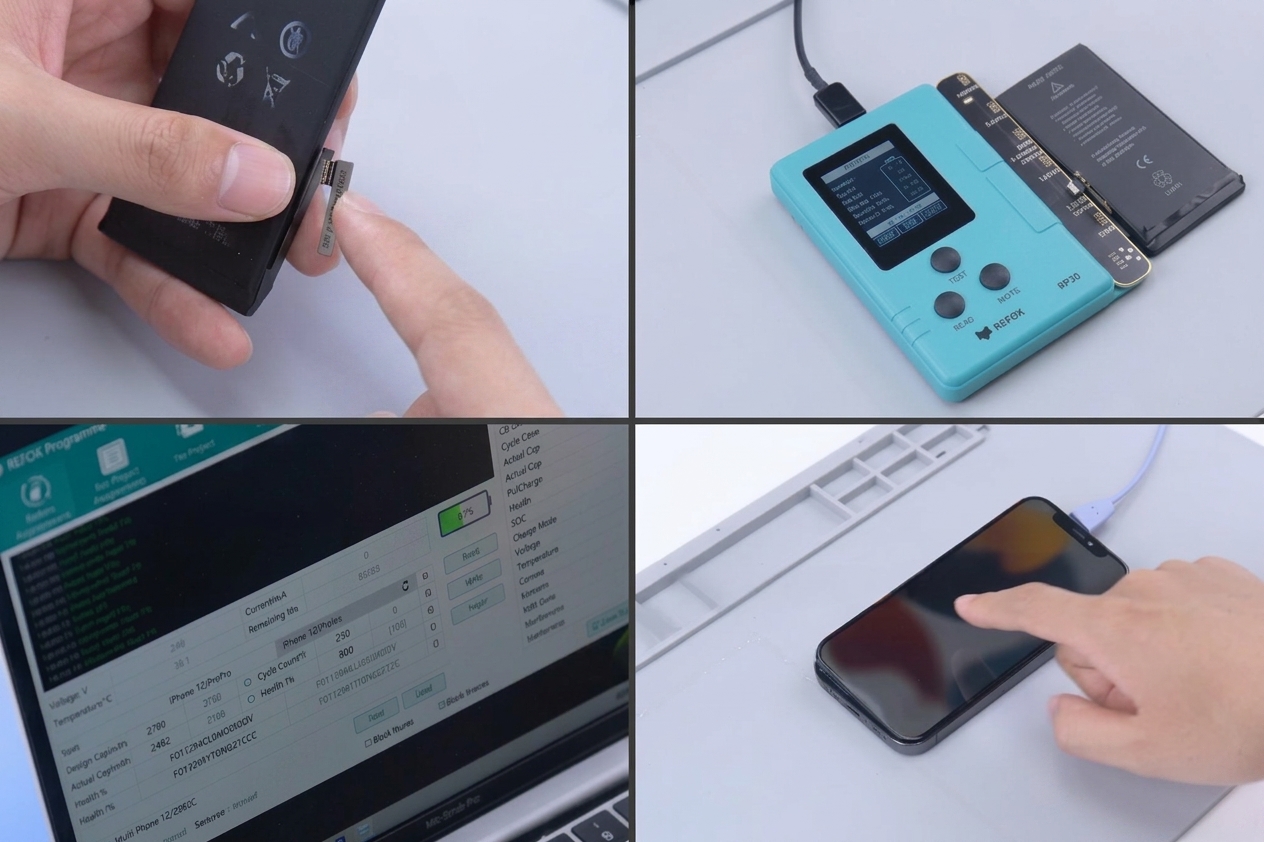
This is probably the most important point. A battery with the biggest mAh number isn't automatically the best battery. If the cell quality is poor, the fuel gauge is inaccurate, or the battery-management board draws too much power or doesn't handle temperature properly, the extra capacity won't mean much. That's why the specifications behind the numbers matter.
With the REPART iPhone 13 battery, the 3,450mAh capacity is only one part of the story. The TI chip solution, Impedance Track fuel gauging, low static board consumption, thermal monitoring, and Pure Cobalt cells are there to support how the battery operates in everyday use.
For a repair shop or refurbisher, those details can matter just as much as the capacity increase itself.
The Bottom Line
High-capacity iPhone batteries can provide longer use between charges, but the improvement isn't the same for every model. The best way to judge one is to look past the words "high-capacity." Check the actual mAh increase, cell quality, battery-management system, temperature monitoring, and how accurately the battery reports its remaining charge.
For REPART's iPhone 13 battery, the 3,450mAh rating provides roughly 7% more nominal capacity than the standard 3,227mAh figure. Other models can offer different gains, and some batteries in REPART's wider high-capacity range are rated considerably higher than standard-capacity replacements. So rather than thinking of a high-capacity battery as a miracle upgrade, think of it as something more practical: more stored energy, with the electronics and cell design needed to manage that energy properly.
iPhone batteryiPhone aftermarket batteryhow to select iPhone batteryiPhone Batteriesbattery replacement
Related Products
Comment
CATEGORIES
FEATURED POSTS
WHAT'S HOT
Face ID Not WorkingREWA-Selectedboardview softwareFace IDiPhone batteryiPhone Partsclamp fixtureFace ID Repairmobile phone repair shop nameREWA Repair
Write a comment