
 Repair Tools
 Glass Refurbishment
 Chips & Components
 Accessories
 Apple
Apple
 Mac
Mac
 Samsung
 Brands
 REPART
 Other Parts
No relevant results
Original vs. Aftermarket iPhone Parts: What Actually Matters
Aug 19, 2026
1.2 k
0
An iPhone battery is three things at once: a lithium cell (the energy store), a Battery Management System (BMS) board that manages charging, and an authentication IC the chip iOS uses to verify the part is genuine. Each tier handles all three differently.
| Tier 1 | Tier 2 | Tier 3 | Tier 4 |
| Original (OEM) | Used/Pull | Premium Third-Party | Budget Aftermarket |
| Apple factory new. Full iOS integration, highest cost. | Genuine Apple parts pulled from used devices. | New cells/panels built to near-OEM spec. REWA, REPART. | Generic assemblies. Lowest cost, shortest lifespan. |
iPhone Battery Comparison
A battery consists of three parts: a lithium cell (the energy store), a battery management system (BMS) board for charging, and an authentication chip for checking authenticity. All three are handled differently by each tier.
| Attribute | Tier 1: Original (OEM) | Tier 2:Used-Pull | Tier 3: Premium 3rd-Party | Tier 4: Budget Aftermarket |
|---|---|---|---|---|
| Cell source | Apple factory, new | Pulled from used iPhone | New cell, certified supplier | Unknown / unverified |
| Health at sale | 100% | 80–95% typical | 100% | Unverified |
| Authentication IC | Apple OEM | OEM (carried over) | Diagnostic-compatible | None / incompatible |
| iOS pop-up warning | None | "Used" label in Settings | None (diagnostic-compatible) | "Unknown Part" persistent |
| Health % visible in iOS | Yes | Yes (inherited count) | Yes | No - disabled by iOS |
| Design cycle life | 500–1,000 to 80%* | Reduced (pre-cycled) | 500+ guaranteed | Unpredictable |
| Certifications | Apple internal | None | CE / FCC / MSDS / UN38.3 | Rarely certified |
| Warranty | Apple 90 days–1 yr | None typically | 6–12 months | Short or none |
| Relative price | $$$$ | $$ | $$$ | $ |
*Apple extended design cycle life from 500 cycles (iPhone 14 and earlier) to 1,000 cycles for iPhone 15 and later a meaningful improvement most buyers overlook.
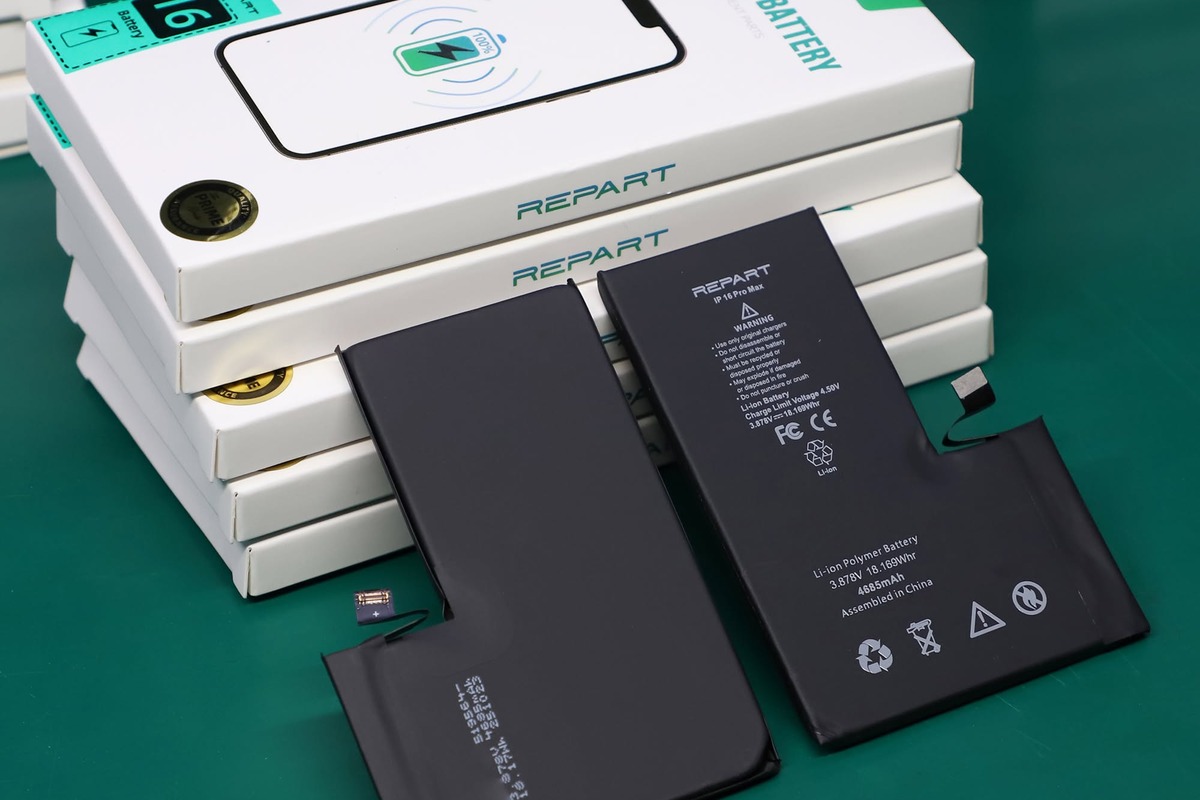
What is a diagnostic-compatible battery?
Batteries manufactured by third-party iPhone parts brands like REWA include a proprietary authentication chip pre-programmed to pass iOS' encrypted hardware handshake. Therefore, health reports are accurate, warnings aren't persistent, and there is no need to transfer chips.
The BMS Authentication Problem
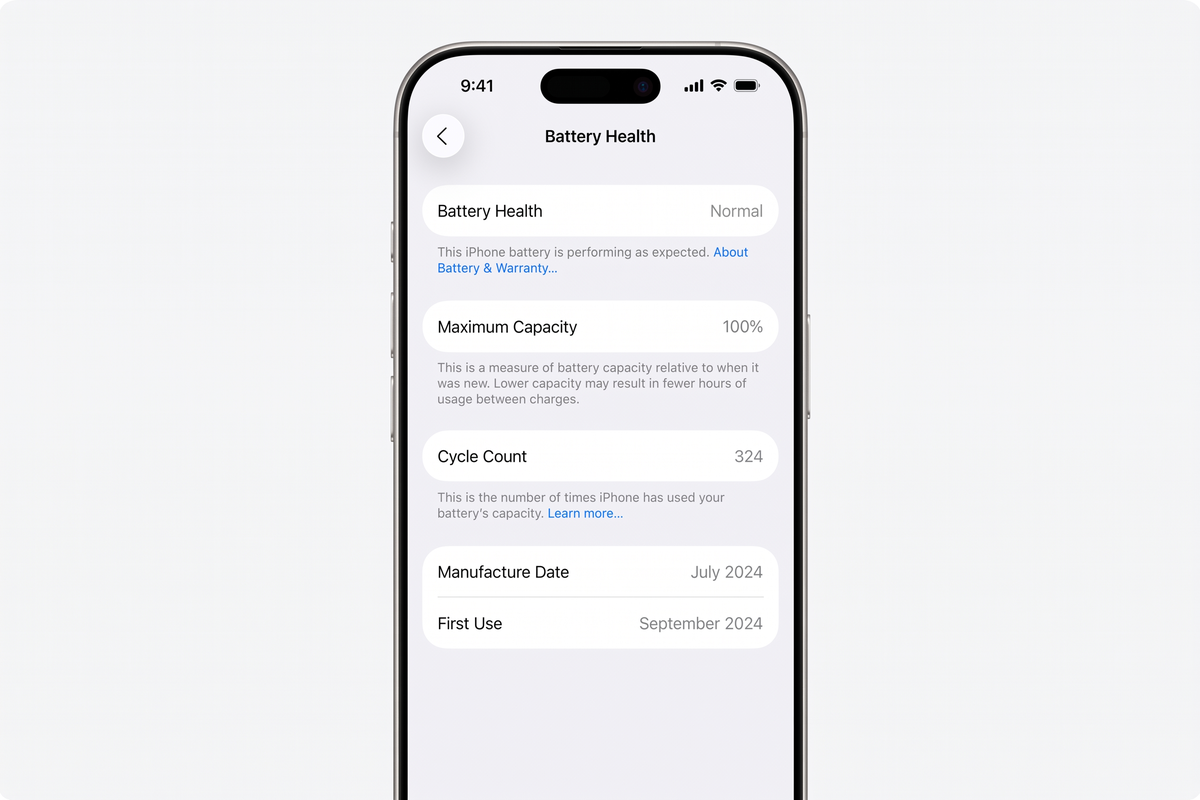
Since iPhone XS, Apple batteries contain an authentication IC that performs an encrypted handshake with the logic board. Whenever the handshake fails, iOS disables the Battery Health display and flags the part as incompatible, mismatched, or absent. There are two types of aftermarket iPhone batteries: ones without the IC entirely and those with a generic IC that fails the check. The battery still charges and works, but its health data is permanently unavailable.
The Used-Pull Nuance
A used-pull battery is a genuine Apple battery that has already been installed and used in another iPhone. On supported models, iOS can verify the battery as a genuine Apple part after the repair and calibration process is completed. For iPhone 15 and later running iOS 18 or later, Settings will show the battery as "Used" rather than new.
Because the battery has already been used, its battery health, cycle count, and first-use history don’t reset when it is moved to another phone. So if a supplier sells a battery at 85% health, that means the battery has already degraded to roughly 85% of its original maximum capacity it is not equivalent to a new battery. Apple also notes that previously used parts can have inconsistent performance depending on their prior use and condition.
For that reason, always buy used-pull batteries from a trusted supplier with clear grading standards, and check the reported battery health, cycle count, physical condition, and warranty whenever possible.
iPhone Screen Comparison
An iPhone screen replacement involves more than simply swapping the glass and display. The overall result depends on the display technology and quality, such as OLED or LCD, the touch and display electronics that control how the screen communicates with the iPhone, and the calibration data used for features such as True Tone, brightness, and color accuracy. Apple calibrates genuine replacement displays through its repair process, and on supported models Repair Assistant installs the required calibration data after installation.
Lower-quality aftermarket screens may still work, but they can differ noticeably in brightness, color accuracy, touch response, power consumption, and True Tone performance. In practice, each screen tier handles these areas differently, which is why two replacement displays that look similar on paper can provide very different everyday experiences.
| Attribute | Tier 1: Original | Tier 2: Used-Pull | Tier 3: Premium 3rd-Party | Tier 4: Budget Aftermarket |
|---|---|---|---|---|
| Panel technology | Soft OLED | Soft OLED (genuine) | Soft / Rigid OLED | LCD or In-cell LCD |
| True black / contrast | Infinite contrast | Infinite contrast | Infinite contrast | ~1,500:1 (backlight bleed) |
| Peak brightness | Device spec | Aged / varies | 800–1,000+ nits | 250–500 nits |
| True Tone | Yes, factory-calibrated | Depends on IC state | Restorable (IC transfer or diag-compatible) | Permanently unavailable |
| Face ID | Full support | Full support | Supported (OEM flex retained) | At risk if flex incompatible |
| iOS pop-up warning | None | "Used" label | None (diagnostic-compatible) | "Unknown Part" 15 days |
| Impact resistance | Standard rigid glass | Aged / standard | Flex substrate — more resistant | Rigid glass, brittle |
| Color gamut | DCI-P3 | DCI-P3 (aged) | DCI-P3 | sRGB or approximated |
| ProMotion (120 Hz) | Yes (Pro models) | Yes if Pro-sourced | Available (REPART 120 Hz line) | 60 Hz only |
| Certifications | Apple internal | None | CE / FCC / RoHS | Rarely |
| Relative price | $$$$ | $$–$$$ | $$$ | $–$$ |
Why LCD is a Downgrade on iPhone 12 and Later
Starting with the iPhone 12, Apple moved its main iPhone lineup to OLED displays, while the iPhone SE continued using LCD. That means an “LCD screen for iPhone 14” is an aftermarket conversion rather than a replacement that matches the display technology Apple originally designed for the phone.
These budget LCD replacements can still make the phone usable and may cost considerably less, but they generally cannot match a good OLED for deep blacks, contrast, color quality, brightness, and viewing experience. OLED pixels can also switch off individually when displaying black, while an LCD relies on a backlight that remains powered, so Dark Mode does not provide the same display power-saving advantage as an LCD replacement.
Exact brightness varies widely between aftermarket screens, so it is better to judge a specific panel by its tested specifications rather than assuming every budget LCD falls within a fixed unit range. Apple continues to use OLED displays in its new iPhone 17 models as well.
Soft OLED vs. Hard OLED vs. LCD
Apple introduced OLED with the iPhone X, and its modern OLED iPhone displays use flexible panel construction rather than the rigid glass-substrate panels commonly sold as hard OLED replacements. In the repair market, soft OLED generally refers to an OLED built on a flexible plastic substrate, which can better tolerate bending and impact than a rigid glass-based hard OLED panel.
Hard OLED screens are usually cheaper, but their rigid construction makes the display layer more vulnerable to cracking after a drop. LCD replacements work differently: they need a backlight behind the entire panel, so they cannot switch individual pixels completely off for true black, are typically thicker, and do not get the same dark-screen power-saving advantage as OLED, where each pixel produces its own light.
The Diagnostic-Compatible Screen Breakthrough
REWA's diagnostic-compatible aftermarket iPhone screens are designed to work with Apple's Repair Assistant without requiring technicians to transplant the original display IC or manually program True Tone data. On supported models, the replacement can complete the diagnostic process without triggering the usual "Unknown Part" warning, while features such as True Tone remain available without the traditional chip-transfer procedure. REWA markets this as a major step forward for aftermarket screen repair because it removes one of the most difficult and time-consuming parts of display replacement.
Which Part Should You Actually Buy?
The right tier depends on the device, the use case, and who is doing the repair. These are the scenarios that matter in practice.
| Scenario | Recommendation | Explanation |
| iPhone (14/15/16/17) | Premium Third-Party | Soft OLED performance is near-OEM; diagnostic-compatible version avoids any iOS warning. The $150–200 delta over budget parts is worth it on a $1,000+ device. |
| Older iPhone (X, XR, 11) | Budget to Mid-Tier | Device resale value may not justify premium parts. A mid-tier OLED or LCD gets the phone functional. |
| Professional repair shop | Premium 3rd-Party (Diagnostic-Compatible) | Customer complaints about iOS warnings damage shop reputation. Diagnostic-compatible parts from REWA/REPART eliminate the issue and carry a warranty to back returns. |
| Resale prep or full authenticity required | Used-Pull / OEM Refurbished | A genuine Apple part from a verified grade-A used-pull source maintains resale value and passes any OEM check. Verify health grade before purchasing. |
| Corporate / MDM-managed device | Original (OEM) | MDM security profiles can flag non-genuine parts. Apple Authorized Service Provider repair maintains enterprise compliance. |
| You have AppleCare+ and want zero friction | Original (OEM) | With AppleCare+, Apple's repair cost is ~$29–99. Third-party cost advantages disappear when AppleCare covers the delta. |
Frequently Asked Questions
Will a third-party iPhone battery show an Unknown Part message?
It can, but not every third-party battery behaves the same way. Apple says an iPhone may show Unknown when a replacement battery is nongenuine, cannot be verified, has been modified, or has not been properly linked to the device after repair. Some newer diagnostic-compatible aftermarket batteries, including products sold by REWA, are designed to complete Apple's Repair Assistant process.
Is a used-pull iPhone battery safe to install?
A used-pull battery can be a reasonable replacement if it is genuine, undamaged, properly tested, and still has sufficient capacity, but being an original Apple part does not make it equivalent to a new battery. On supported models, particularly iPhone 15 and later with iOS 18 or later, Apple allows a genuine battery previously installed in another iPhone of the same model to be reused and identifies it as Used in Parts and Service History. Its previous usage does not disappear: battery capacity, cycle count, and first-use history reflect the battery's actual life. So a battery sold at 90% health has already lost roughly 10% of its original maximum capacity. When buying a used-pull battery, check its health, cycle count, physical condition, testing history, and supplier warranty, and avoid batteries showing swelling, damage, or other signs of deterioration.
Do third-party iPhone screens keep True Tone?
Some aftermarket iPhone screens can retain or restore True Tone, but it depends on the screen, repair method, iPhone model, and iOS version. Apple warns that True Tone may not work correctly with a nongenuine display because replacement displays may not have the same calibration and integration as an original Apple screen. Traditional aftermarket repair methods can involve transferring or programming display-related data, while newer diagnostic-compatible screens are designed to simplify the process. For example, REWA currently sells diagnostic-compatible screens that it says can complete Repair Assistant without an original display IC transplant, and some models do not require a separate True Tone restoration procedure. It is therefore inaccurate to say that every LCD or In-cell screen is physically incapable of supporting True Tone; compatibility should be checked for the exact replacement screen and iPhone model.
What is the difference between Soft OLED and Hard OLED iPhone screens?
The main difference between Soft OLED and Hard OLED is the substrate underneath the OLED panel. Soft OLED uses a flexible polyimide-based substrate, while Hard OLED uses a rigid glass substrate. Both are self-emitting OLED technologies, so both can produce deep blacks and high contrast without an LCD backlight. The flexible construction of Soft OLED makes it more tolerant of bending, frame flex, and installation stress, while rigid Hard OLED is generally more sensitive to uneven pressure or housing deformation and is commonly positioned as the more affordable aftermarket option. However, Soft OLED does not automatically guarantee better brightness, color accuracy, touch response, or overall quality a well-made Hard OLED can outperform a poor-quality Soft OLED, so the individual screen specification and supplier quality still matter.
The Summary in Three Sentences
For most people repairing a current flagship iPhone, Tier 3 Premium diagnostic-compatible parts from REWA or REPART hit the sweet spot: near-OEM display and battery performance, no iOS warnings, certified, and under warranty at a fraction of Apple's service price. Tier 1 Original parts are worth the premium only if you have AppleCare+, need enterprise compliance, or are preparing a device for resale at OEM condition. Tier 4 Budget aftermarket is acceptable only for low-value devices where function matters more than features expect degraded brightness, possible ghost touch, and persistent iOS notifications.
iPhone screeniPhone displayiPhoneimportant display messageiPhone BatteriesiPhone restorationiPhone Parts
Related Products
REPART Soft OLED Screen Replacement for iPhone 13 - Prime (Supports IC Transfer)
Sign In To See PriceREPART Soft OLED Screen Replacement for iPhone 16 - Prime (Supports IC transfer)
Sign In To See PriceComment
CATEGORIES
FEATURED POSTS
WHAT'S HOT
Face ID Not WorkingREWA-Selectedboardview softwareFace IDiPhone batteryiPhone Partsclamp fixtureFace ID Repairmobile phone repair shop nameREWA Repair
Write a comment